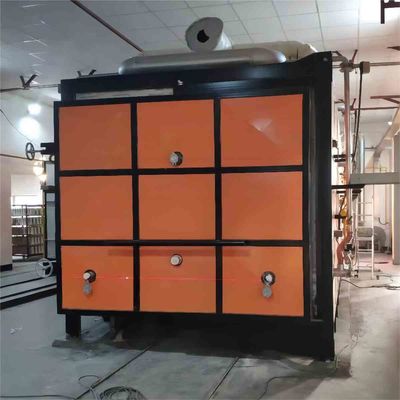
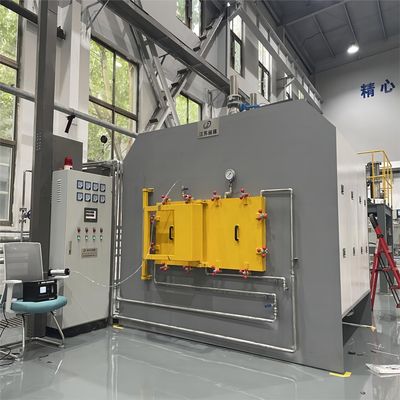
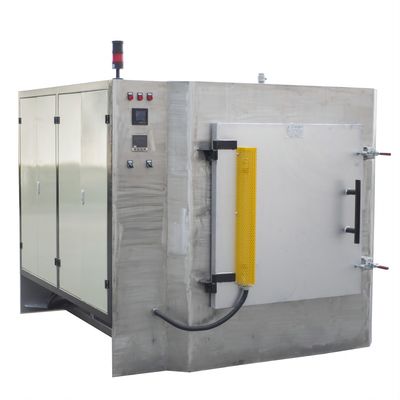
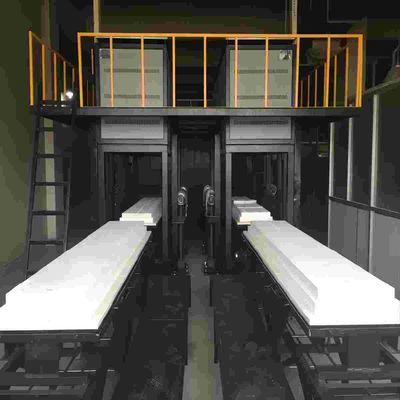
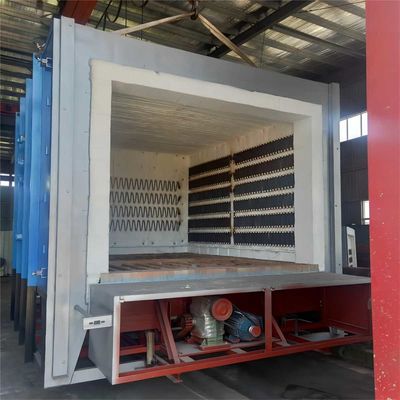
The pit-type carburizing furnace is a batch-type resistance furnace. The electric furnace is designed and manufactured according to the user's specific product requirements. It is mainly used for heat treatment heating of large ring parts and extra-large bushings, such as gas carburizing. This electric furnace can also be used for quenching, annealing, and tempering processes.
1﹑Technical Specifications
1. Rated Power: 350KW
2. Rated Voltage: 380V, 3-phase, 50HZ
3. Rated Temperature: 950℃ (adjustable)
4. Number of Heating Zones: 3 zones
5. Heating Element Connection: YYY
6. Effective Working Dimensions: ¢2500×1500㎜
7. Empty Furnace Heating Time: ≤3.5h
8. Empty Furnace Power Loss: ≤11%
9. Temperature Control Accuracy: ±2℃
10. Furnace Temperature Uniformity: ≤5℃
11. Hot Air Circulation Fan: WGB-4AI
12. Carburizing Atmosphere Uniformity in Effective Area: ≤0.05%
13. Equipment Overall Dimensions: ~¢3400×2300㎜
14. Equipment Total Weight: ~12T
2﹑Structure:
The equipment mainly consists of: the main heating electric furnace, furnace cover and lifting/moving mechanism, hot air circulation and air guiding device, carbon potential control system, and electrical temperature control system. The following is a brief introduction to the structure and performance of the main components of the equipment.
1) Main Heating Electric Furnace: It mainly consists of the furnace cover, main furnace body, furnace lining, and heating elements.
1.1) The furnace cover is made of welded steel sections and steel plates. The seal between the furnace cover and the furnace chamber uses graphite asbestos packing and rubber packing for double-layer sealing, ensuring good airtight performance of the resistance furnace during operation. The inner side of the furnace lid is welded from stainless steel plates to form an air guide channel that allows for smooth airflow, suitable for fan operation. This channel, along with the baffle plates of the ventilation unit, guides the airflow from the fan, ensuring that the hot air circulates through the ventilation duct as intended without interference. (Because this is a large electric furnace, the operating temperature during carburizing is high. Ordinary stainless steel plates cannot withstand prolonged use at high temperatures. Furthermore, the frequent opening and closing of the furnace lid causes frequent temperature changes, increasing thermal expansion and contraction, and thus increasing the deformation coefficient of the material, making it prone to deformation. Considering the operating conditions of large electric furnaces and general experience, and given that the furnace lid is difficult to repair, even if repair is possible, it is very difficult. Therefore, the stainless steel in this area must be made of high-temperature resistant and corrosion-resistant stainless steel plates. During the manufacturing process, the deformation coefficient of the furnace lid is calculated. A special and improved method is used to weld and manufacture the inner stainless steel plate of the furnace lid, ensuring that the furnace lid can be used for a long time under high-temperature and corrosive conditions without deformation, increasing the service life of the electric furnace (reducing the repair cycle of the electric furnace).
1.2) Main furnace body: Mainly welded and formed from steel plates and structural steel, its structure is robust and durable.
1.3) Furnace lining: Constructed with 0.6 ultra-lightweight refractory bricks, the protective layer uses refractory fiber felt insulation bricks (diatomaceous earth) and vermiculite powder filling to ensure that the furnace temperature does not leak out, achieving energy-saving effects. Due to the large volume of the electric furnace, high-temperature resistant binders are added when laying the refractory bricks to increase the strength of the brick joints and enhance the strength of the refractory bricks, thus increasing the service life of the electric furnace. The use of shaped refractory bricks increases the sealing and durability of the furnace lining.
1.4) The heating elements are made of 0Cr27AL6Nb alloy high-resistance wire, wound and formed, and evenly distributed around the furnace lining to achieve optimal heat distribution. This resistance wire has good heating performance and is designed into 18 groups with equal power. The power distribution density is adjusted according to the heat transfer law, thus achieving uniform temperature distribution and meeting the specified surface load requirements.
2) Furnace Lid Lifting Device:
This device mainly consists of a steel frame for lifting and moving the furnace lid, a furnace lid lifting mechanism, and a furnace lid moving mechanism.
2.1) The lifting and moving steel frame is welded from shaped steel and steel plates, ensuring a simple, robust, durable, safe, and reliable structure. The furnace lid lifting uses a two-point balanced positioning system, with a single point utilizing an electric hoist and chain structure to lift the furnace lid smoothly and accurately; this keeps the power source away from high-temperature points, ensuring the long-term normal operation of the equipment. The furnace lid uses a positioning and centering support column structure, with the support column seated on a steel ball for flexible rotation.
3) Hot Air Circulation Unit and Air Guiding Device
Water-cooled sealed circulation fans are designed in the furnace lid to force the furnace atmosphere to circulate in the specified direction, ensuring uniform heating and uniform carbon potential concentration. The fan shaft and blades are made of 0Cr25Ni20Si2 heat-resistant steel, and the air guide plate and air guide barrel are appropriately combined, made of 1Cr18Ni9Ti material.
4) Furnace Chamber: Made of 310S high-temperature resistant stainless steel plate. The bottom of the furnace chamber is open, and the bottom flange of the furnace chamber and the bottom flange of the material platform are simultaneously inserted into the prefabricated sealing groove at the bottom of the furnace. High-flash-point heavy oil is used in the groove for sealing, isolating the air inside the furnace chamber from the outside.
5) Carburizing Liquid Dropping Device and Carbon Potential Control
The carbon potential control system (including oxygen probe, carbon control instrument, flow meter, solenoid valve, etc.) uses a complete system imported from Honeywell, USA, which can preset multiple process parameters for automatic program control. The liquid dropper is made of corrosion-resistant stainless steel.
6) Electrical Temperature Control System
6.1) In addition to the conventional automatic air switch and AC contactor, the main heating circuit uses SCR power control independently for each zone, and is equipped with a forced cooling fan, overheat protection, and RC absorption circuit, as well as output voltage and current display.
6.2) Temperature control uses a Shanghai Guolong TCW-32B programmable intelligent meter, with a "K" type thermocouple, and a PID output current of 4-20mA, and auxiliary control output contacts.
6.3) The recorder uses a Shanghai Dahua XWGJ-101 single-pen circular electronic differential pressure gauge.
6.4) The upper, middle, and lower temperature control, carbon potential control, and the operating mechanisms for each furnace system are all designed on the same control cabinet panel, arranged concisely, aesthetically, and logically, with clear displays, facilitating operation and maintenance; the internal electrical components are arranged compactly, logically, and with clear layering.
6.5) The electrical furnace's mechanical parts and heating elements are subject to full interlocking control. That is, after loading, the power to the furnace heating elements can only be switched on after the furnace lid is completely closed. When the workpiece heating is complete and the lid is opened, the furnace automatically switches off the power to the heating elements. Only after the lid has risen to its position can it be rotated horizontally and moved away. After the lid has moved to its position, the power for lowering the lid is automatically switched on. Only after the lid has lowered to its position can the power to the heating elements and the ventilation unit be automatically switched on. This forms an automatic interlocking control system, preventing unnecessary damage and safety hazards due to incorrect operation, making the equipment operation safer and more reliable.

 Your message must be between 20-3,000 characters!